“Molded insert” is not one material. It spans a family of fiber parts that ranges from a rough, half-inch-thick appliance cradle to a smooth, thin-walled cosmetic tray, plus the thermoformed plastic trays that compete with them on clarity and precision. Choosing well means understanding what each process can actually form, how much it protects, and what it costs you in tooling, lead time, and recyclability. This is a materials-level look at molded pulp and thermoformed inserts so you can match the process to the product rather than to whatever a supplier happens to run.
The molded fiber family, sorted by wall thickness
Molded fiber is grouped by how it is formed, and wall thickness is the quickest way to tell the types apart. Thick-wall parts run roughly 3/16 to 3/8 of an inch, about 4.8 to 9.5 millimeters, with a smooth inner face and a rough outer one; this is the heavy-duty end used for appliances, automotive parts, and glass containers. Transfer-molded parts sit around 1/8 to 3/16 of an inch, near 3.2 to 4.8 millimeters, and allow more precise detail, which is why they carry electronics and lighter consumer goods. Thermoformed thin-wall fiber is thinner still, about 3/32 to 5/32 of an inch, roughly 2.4 to 4.0 millimeters, and is dried directly in the mold to produce smooth surfaces with minimal draft, the look you see under cosmetics and specialty retail.
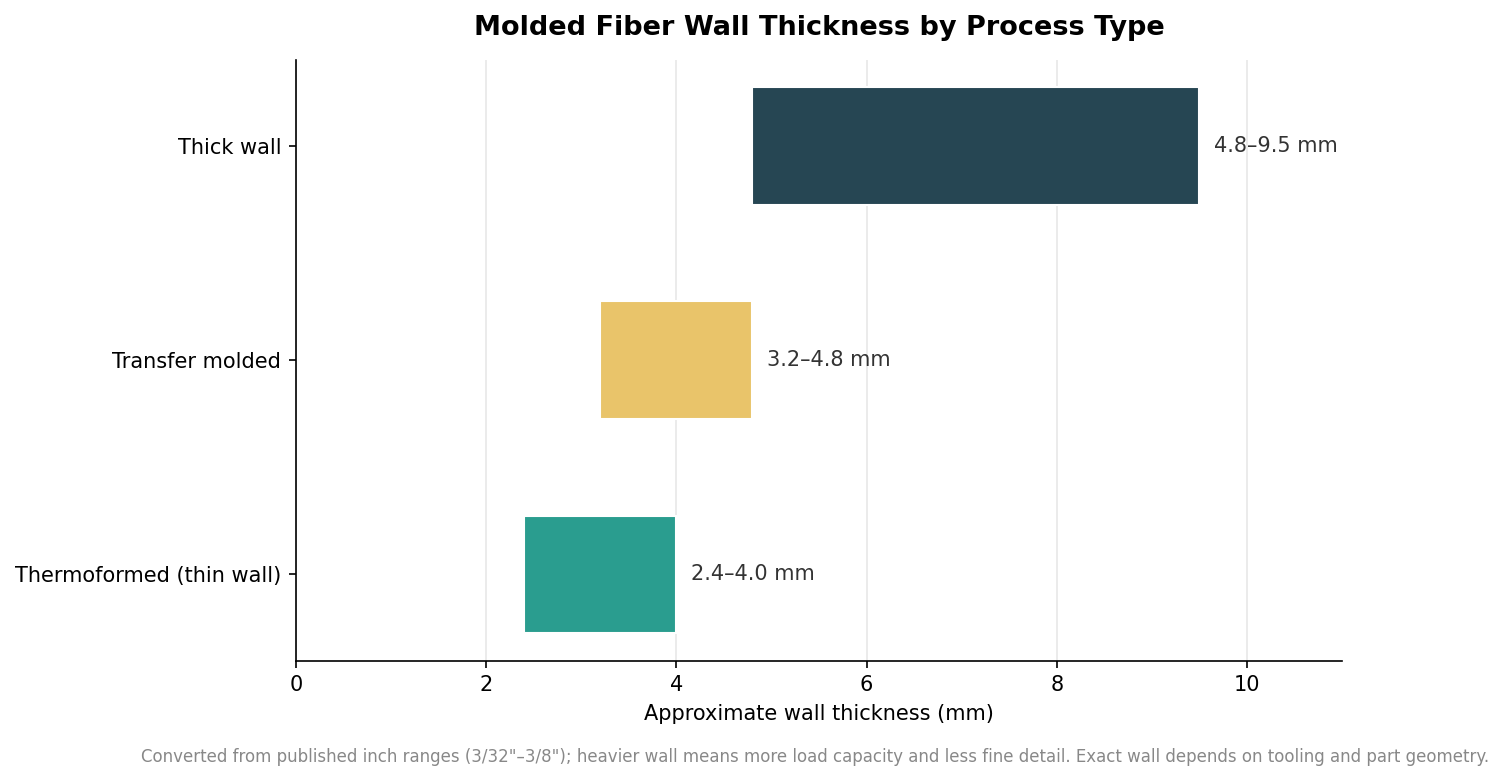
A fourth category, often called processed molded fiber, is any of the above taken through secondary steps such as die-cutting, hot pressing, coloring, or printing to create hinged, ventilated, or branded parts. That extra finishing raises both cost and lead time, so it is worth requesting only where the presentation genuinely calls for it. As a rule, thicker walls buy load capacity and forgiving tooling, while thinner walls buy finish and detail at a higher unit cost and a narrower protection window.
What molded pulp can and cannot form
Fiber has real geometric limits, and designing against them prevents disappointment. Because wet fiber springs back as it dries, molded pulp holds looser dimensional tolerances than injection or thermoforming, so it is a poor choice when a part must snap precisely to a rigid component. Minimum wall thickness is around 0.7 millimeters for wet-pressed parts, draft angles typically need to be in the 3 to 5 degree range so the part releases from the tool, and true undercuts are not possible without secondary operations. Pulp is also opaque at every specification, which rules out any design that depends on seeing the product through the tray. None of this makes pulp weak; it makes it a material you design nests and pockets for with generous radii and draft, rather than tight snap features.
Thermoformed plastic where precision or clarity wins
Thermoformed plastic trays, usually PET or its recycled form rPET and sometimes PVC, exist for the cases pulp cannot cover. They achieve tighter dimensional tolerances, form thinner walls, can be molded with undercuts and snap detail, and offer a transparent option that shows the product on a retail shelf. That precision is why electronics kitting, medical device trays, and premium retail sets often specify a clear formed tray. The trade-offs are environmental and mechanical: a rigid plastic tray transmits impact more directly to the product and, on the disposal side, is rarely accepted curbside. If clarity or a precise fit to a hard product is the priority, thermoformed plastic earns its place; if it is not, the case for fiber gets stronger quickly.
How each material actually absorbs shock
Protection works differently across these materials, and the mechanism matters more than a single cushioning number. Molded pulp absorbs energy through progressive fiber deformation: the wall crushes gradually and spreads the load, and it holds up better than expanded foam across temperature swings. A rigid thermoformed plastic tray does little cushioning of its own; it locates and immobilizes the product, then relies on the outer box and any secondary cushioning to manage a drop, and it transmits a sharp impact fairly directly. That difference should steer the choice: for a dense, drop-sensitive product, a crushable fiber nest often does more real protective work than a rigid formed tray, while for a light product that mainly needs to be held in position and displayed, the rigid tray is fine. Where the load is high or the drop testing is demanding, validate the specific nest with samples rather than assuming a material class will pass.
Recyclability, lead time, and making the call
The last two variables are usually recyclability and schedule. Molded pulp has two clean end-of-life routes, since unsoiled parts recycle in standard paper streams and soiled ones can be composted, which is why its recyclability rating sits far above thermoformed plastic in most guides. If a plastic-free or curbside-recyclable claim is part of your brand promise, fiber is the straightforward answer. Schedule is the counterweight. Simple die-cut corrugated inserts can turn in roughly one to two weeks, and printed paperboard trays in about ten to twenty days, but any custom-tooled molded part, whether pulp or plastic, commonly takes on the order of three to five weeks at low volume because a tool has to be cut first.
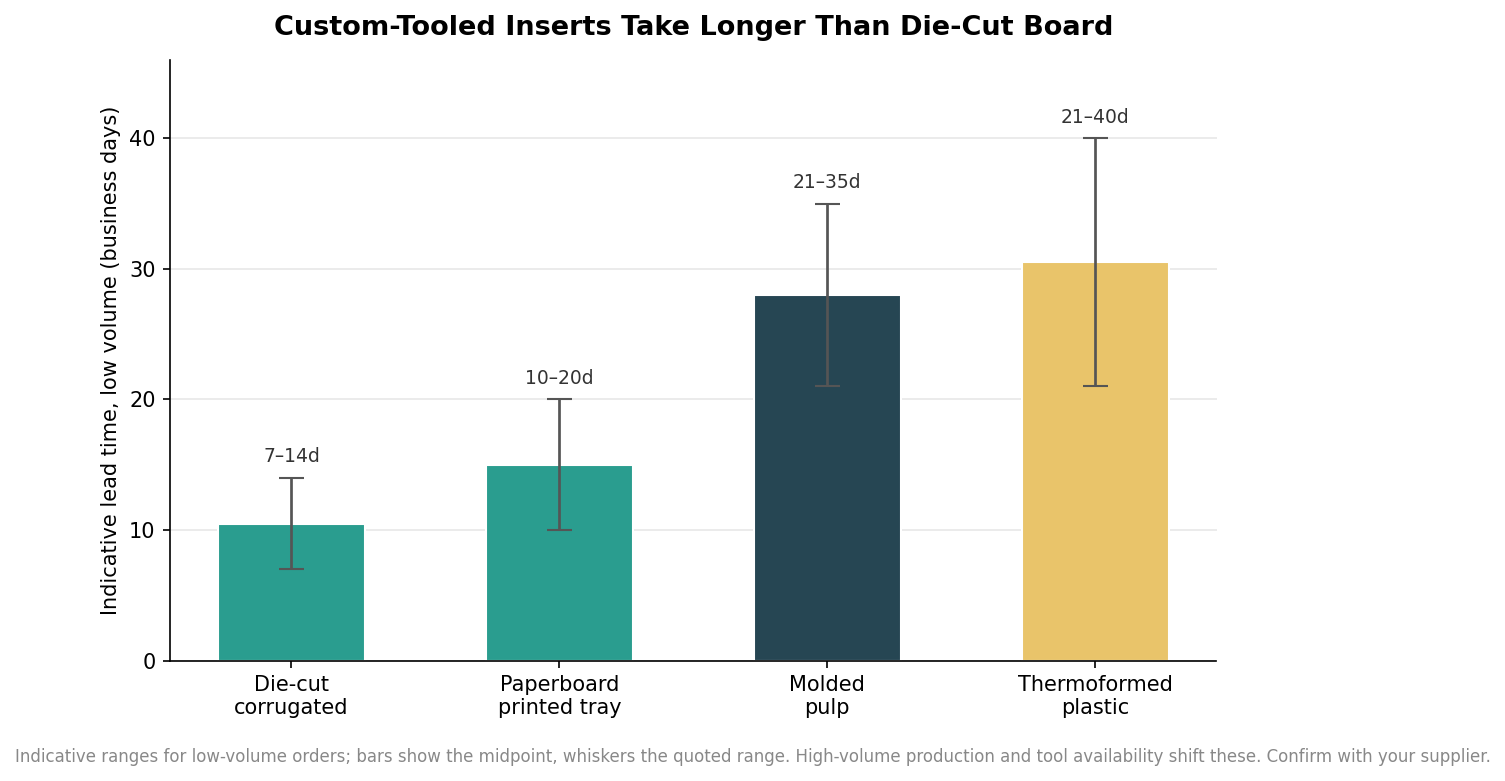
Put together, the decision usually resolves cleanly. Choose molded pulp when you want crushable, sustainable protection for a product that does not demand tight tolerances or visibility, and accept the tooling lead time and looser fit that come with fiber. Choose thermoformed plastic when precision, snap retention, or shelf visibility genuinely drive the design, and you can accept the weaker recyclability. And where volumes are low or the timeline is short, a die-cut corrugated insert may protect the product well enough without any custom tool at all. Match the process to the product’s real requirements, prototype the nest, and confirm it against your own drop testing before committing to a tool.