Expanded polystyrene, the white foam that has cradled fragile products for decades, is quietly being designed out of the box. Some of that pressure comes from customers who now judge a brand by the packaging waste it leaves on the doorstep, but a bigger share comes from law. A growing set of states is making the company that puts packaging on the market pay for what happens to it afterward, and that changes the arithmetic on every insert you spec. If you are choosing box inserts in 2026, the material question and the compliance question have become the same question.
The rules are why this is urgent
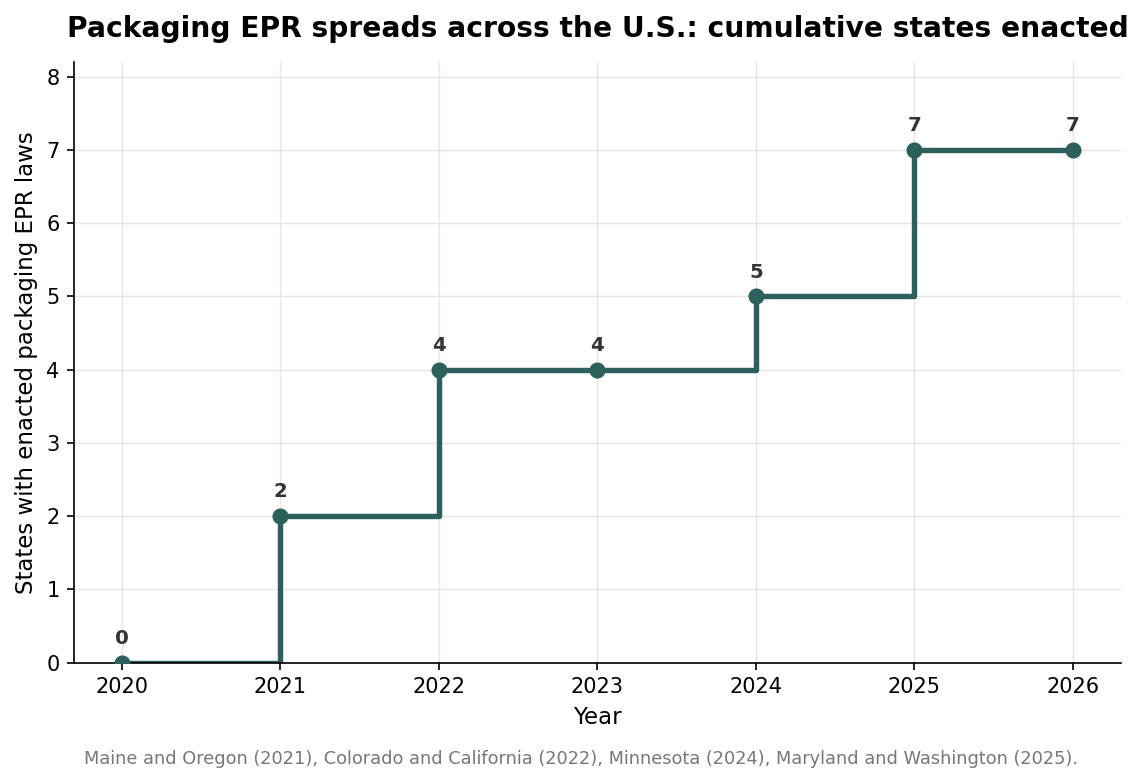
Seven states now have packaging extended producer responsibility laws on the books: California, Oregon, Colorado, Maine, Minnesota, Maryland, and Washington. Extended producer responsibility, or EPR, shifts the cost of collecting and recycling packaging from municipalities to the producers who sell it. Maine and Oregon passed the first such laws in 2021, California and Colorado followed in 2022, and the count has climbed steadily since, as the chart below shows.
The mechanism that matters most for insert selection is eco-modulation. Under these programs the fee a producer pays is not flat; it flexes with how recyclable and how material-efficient the packaging is. Design something that flows cleanly through existing paper recycling and you sit toward the low end of the fee schedule. Ship a fragile item in mixed foam-and-plastic that no curbside program will take, and you pay more, potentially for years. California has gone furthest, with a statutory goal that all covered packaging meet minimum recyclability standards by 2032. The insert you choose today is a line item on a fee schedule tomorrow.
What “recyclable” now has to mean
Curbside-recyclable is the bar, not just recyclable in theory. A material that can technically be recycled at a specialized facility does little for a fee calculation or a customer if it cannot go in a household bin. Fiber-based inserts, meaning molded pulp and corrugated board, clear that bar in most of the country because they ride along with the paper and cardboard stream people already sort. Expanded polystyrene generally does not; it is excluded from most curbside programs and is outright restricted or banned in a number of states.
The second rule is to avoid mixing materials that have to be separated by hand. A paperboard tray with a bonded plastic film, or a corrugated box lined with glued foam, asks the consumer to pull the package apart before recycling, and most will not. The cleanest compliance story, and the simplest one to explain on a label through a program like How2Recycle, is a mono-material insert: paper protecting the product, so the whole package goes in one bin.
Molded pulp, the direct foam replacement
Molded pulp is the closest fiber analog to custom foam for contoured, fragile goods. It is formed from recycled paper slurry pressed into a product-specific cavity, so each unit sits in its own pocket with no movement and no contact between pieces. That makes it a strong fit for bottles, jars, candles, cosmetics, and consumer electronics that need to be held rather than merely cushioned. Because it is made from recycled paper, it is curbside recyclable and often home compostable, which gives it the best end-of-life profile of the common insert materials.
The tradeoff is tooling. A molded pulp cavity requires a custom mold, so there is an upfront tooling investment and a lead time to cut it, which pushes the economics toward larger and repeat runs rather than one-off small batches. Treat exact tooling costs and minimums as supplier-specific and get them quoted against your real annual volume, because the per-unit price falls as the run grows and the mold amortizes. Molded pulp also has practical limits on wall thinness and fine detail, so very small or oddly geometric parts sometimes protect better in foam or a die-cut design.
Corrugated and honeycomb, the workhorses
Die-cut corrugated is the least expensive protective insert and the fastest to bring up, because it uses steel-rule dies rather than molds. Partitions, cells, trays, and folded cradles organize a box, keep units from knocking together, and add stacking strength, which is why they dominate multi-pack and kit configurations. Corrugated is a shining recycling story, but it cushions less than it organizes, so for genuinely fragile single items it is usually a structure that positions the product rather than the sole line of defense against a drop.
Where you need real shock absorption without leaving the paper stream, honeycomb kraft is the material to know. Its hexagonal paper core absorbs impact and distributes load much like expanded foam, which is why it is a leading foam alternative for corner blocks, edge protection, and heavier goods. It is recyclable with paper, ships flat before it is expanded, and pairs well with a corrugated outer for a fully fiber-based system. Between molded pulp for contoured cradling, corrugated for structure, and honeycomb for cushioning, most products that once shipped in foam can be re-solved in paper.
Time the switch around the fee calendar
Producer fees do not all start at once, and that timing is a planning tool. Oregon’s fees went live in mid-2025 and Colorado’s began in 2026, with Maine expected to follow later in 2026 and California projected for 2027; Minnesota, Maryland, and Washington phase in over the following years. The chart below lays out the near-term dates.
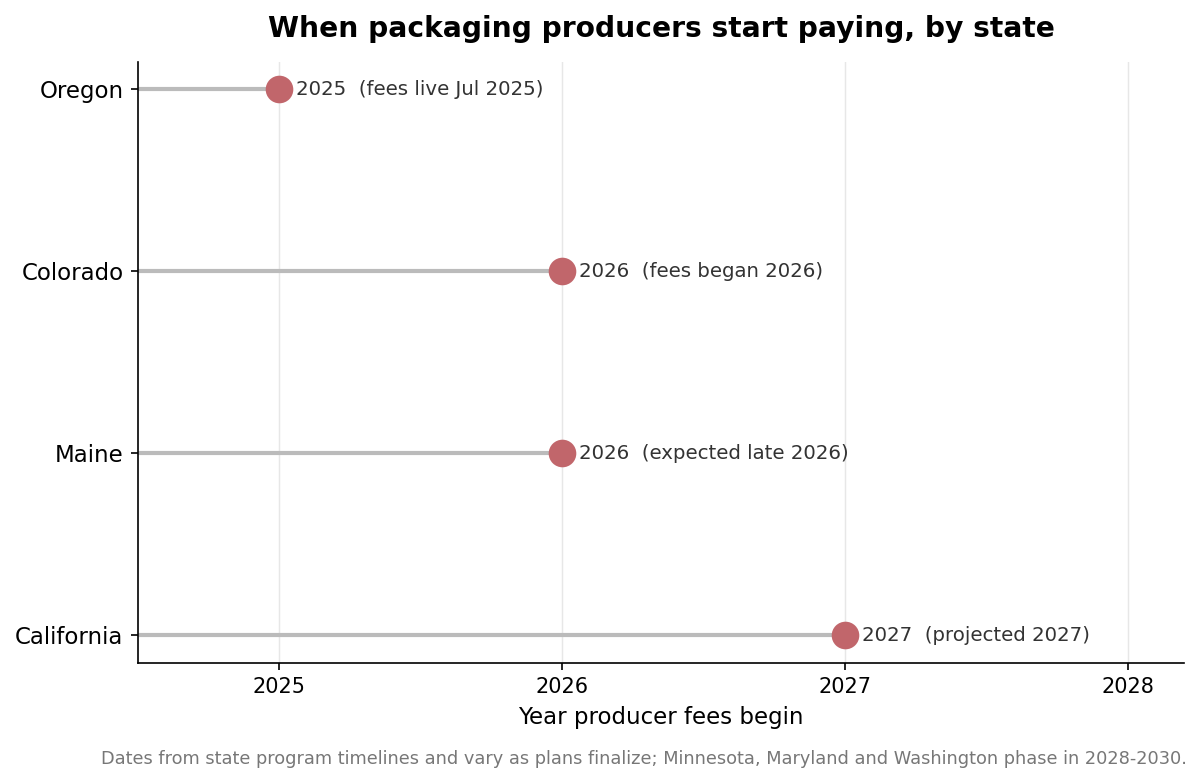
The practical move is to align your redesign with your own tooling lead time rather than with the first invoice. If a molded pulp mold takes weeks to cut and prove out, and your largest markets bring fees online in 2026 and 2027, then a switch started now lands comfortably ahead of the deadline and lets you sell through existing foam stock in an orderly way. Waiting until the fee notice arrives compresses the same work into a scramble. The brands that come out ahead treat the plastic-free insert not as a compliance cost to defer, but as a design decision to make once, cleanly, while there is still time to test it against a real drop.