When people say they need a box insert, they usually mean one of several very different things. A wine shipper, a phone retail box, and a case of glass jars all need an insert, but the right structure for each is not the same, and choosing the wrong one either fails to protect the product or wastes money on protection it does not need. The useful way to choose is to start from the way the product is likely to be damaged and work back to the insert style that prevents it. This guide walks through the main corrugated and film insert types and where each one earns its place.
Match the insert to the failure you are preventing
Products fail in transit in a few characteristic ways. They knock into each other, they slide and hit the box wall, they take a drop that shocks the whole package, or their surface gets scuffed. Each failure mode points to a different insert. Items that damage each other need separation. Items that slide need to be located and held. Items that are shock-sensitive need cushioning or suspension. Once you name the specific risk for your product, the field of insert options narrows quickly, and you avoid the common trap of paying for a heavily engineered insert when a simple one would have done the job.
Layer pads and partitions: the corrugate workhorses
The simplest inserts are flat pads: sheets of corrugated placed at the bottom, top, or between stacked layers. They add stacking strength, keep layers from rubbing, and cost very little, which makes them the default for flat or stackable goods that are not especially fragile. When the risk is item-to-item contact, partitions take over. A partition, sometimes called a cell divider, is a lattice of interlocking corrugated strips that creates an individual pocket for each unit. This is the standard protection for bottles, wine, jars, and glassware, where the whole point is to make sure two glass surfaces never touch during a rough handling event. Partitions are lightweight and cost-effective, and because they are cut to your product count and dimensions, they hold each item in its own space through the trip.
Die-cut trays: nesting the product
When you want a product located precisely, presented well, or held in a specific orientation, a die-cut insert or tray is the answer. This is a piece of corrugated cut and scored so the product nests into a shaped cavity, common in retail boxes and kits where the insert does double duty as protection and as the first thing the customer sees on opening. A tray keeps a product from sliding into the box wall and gives a clean, deliberate unboxing. The tradeoff is tooling and fit: because the cavity is cut to the product, you need a cutting die and an accurate product profile, and design changes to the product can mean a new die. For a stable product sold in volume, that upfront cost amortizes well; for a rapidly changing product, it is a consideration.
Suspension and retention: film for the fragile and the premium
For genuinely shock-sensitive items, film-based inserts change the physics. In suspension packaging, the product is held between two membranes of flexible film stretched across a corrugated frame, so it floats in the center of the box and the film absorbs a drop before the shock reaches the product. It is a strong choice for electronics and fragile high-value goods. Retention packaging works the other way around: a single film sheet holds the product against a tray or backing board, which suits lighter items and gives a striking, product-forward presentation because the item appears to be floating against the film. Retention leans toward presentation and light protection; suspension leans toward maximum drop protection. Both cost more per unit than plain corrugate, so they are worth it when the product’s fragility or value justifies the spend.
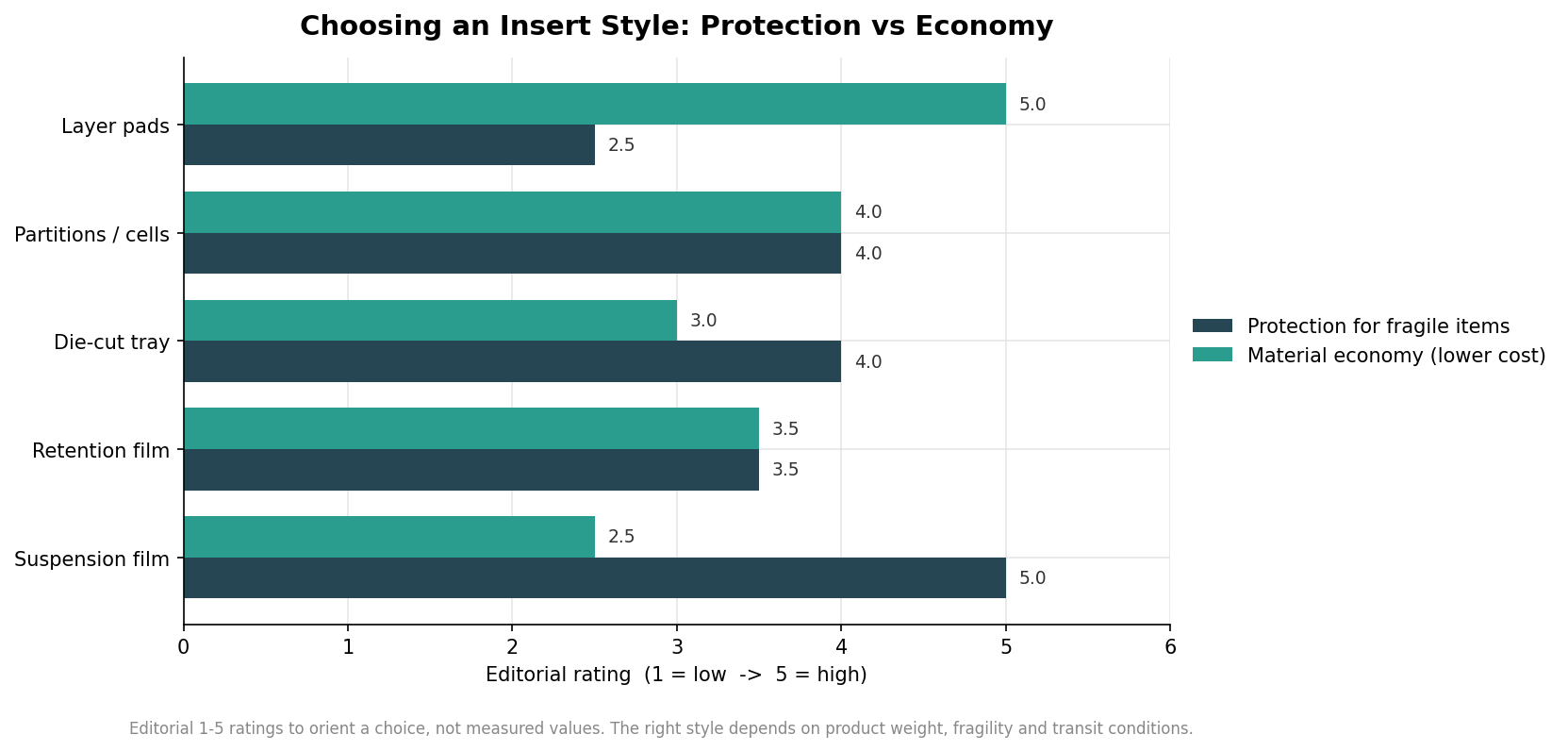
The chart above places these styles against two things buyers weigh constantly: how well the style protects a fragile item, and how economical it is on material. Treat the ratings as orientation rather than measurement, but the pattern is real. Layer pads are cheap but offer the least protection for something fragile; suspension film offers the most protection but the least material economy; and partitions and trays sit in the useful middle where most everyday products live.
The spec under the shape: flute and board
Whatever shape you choose, the corrugated board it is made from has its own spec, and the flute profile is the part that matters most for inserts. Flute is the wavy fluting between the liners, and it comes in grades. F flute is thin, roughly 0.8 to 1.2 millimeters, and prints finely, which suits small retail inserts. E flute at about 1.5 to 2 millimeters is a common insert and e-commerce board. B flute at roughly 3 to 3.5 millimeters adds cushioning and stiffness for heavier or more fragile goods, C flute is a touch thicker at around 4 millimeters, and BC double wall, near 7 millimeters, stacks two flutes for maximum strength.
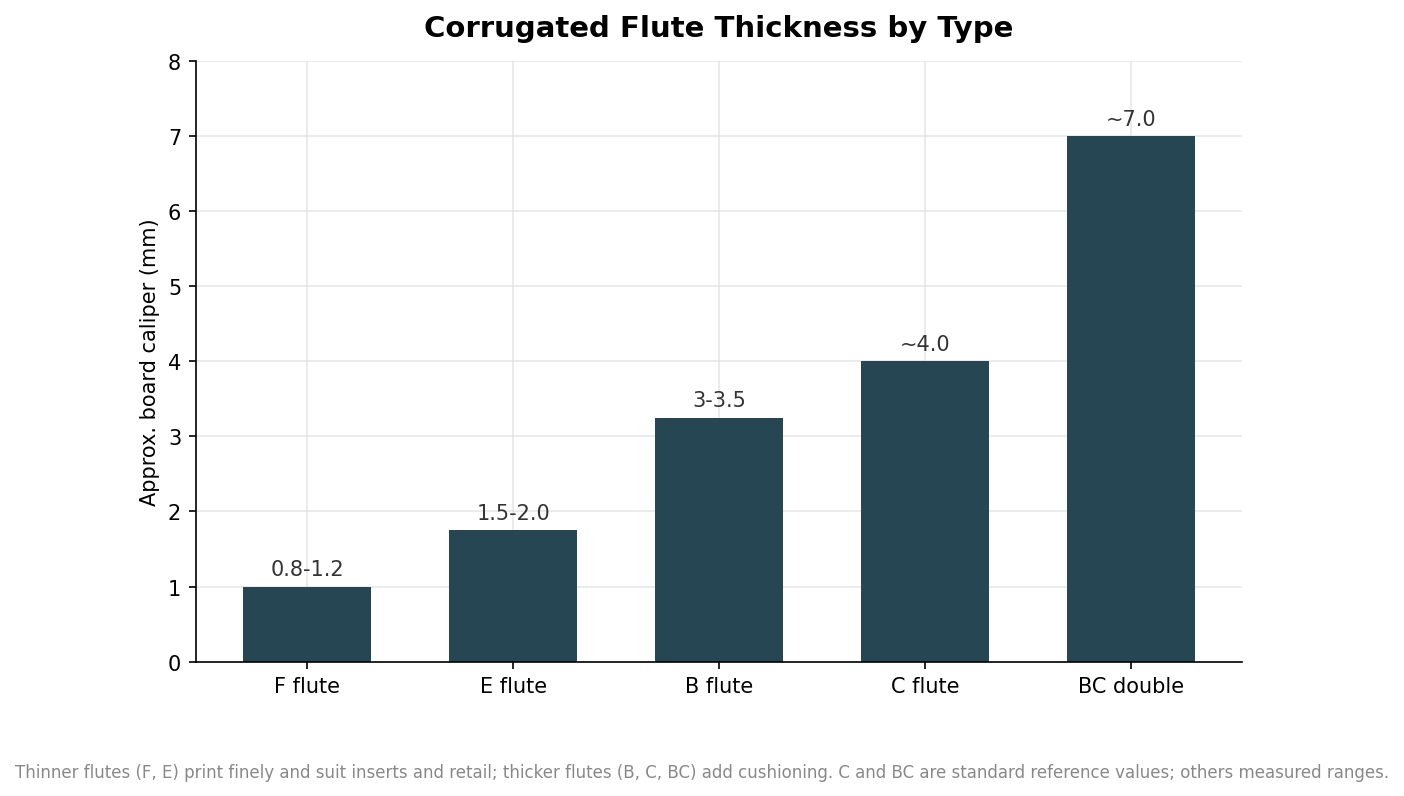
The rule of thumb is straightforward: thinner flutes give you a smoother print surface and a slimmer insert, while thicker flutes give you cushioning and rigidity. A printed retail tray might use E or F flute for its finish, while a partition holding heavy jars leans on B or C for strength. Getting the flute right is how an insert that looks correct on paper actually survives the load it carries.
How to choose, and what to confirm
Put the pieces together by working from the product outward. Name the failure mode, pick the style that prevents it, then choose a flute heavy enough for the weight and fragile enough in print for the presentation you want. Confirm the fit against a real product sample rather than a drawing, because a millimeter of slack is the difference between a snug insert and one that lets the product rattle. Expect corrugated inserts to be quoted on your exact length, width, depth, product count, and weight, and note that minimum order quantities for die-cut and partition work commonly range from around a thousand units into the tens of thousands, so the per-unit cost drops sharply with volume. If your product ships in real quantity and its damage rate matters, it is also worth validating the chosen insert with a transit or drop test before committing to a large run, so the insert you scale is one you have actually seen protect the product.